Axiomatic Construction of Number Systems and Mathematical Objects
Express axioms and mathematical structures as composable Go interface contracts, independent of their concrete representation.
← Mathematical Foundations projects
Question
How can Go interfaces describe what a mathematical object does without deciding how it is represented?
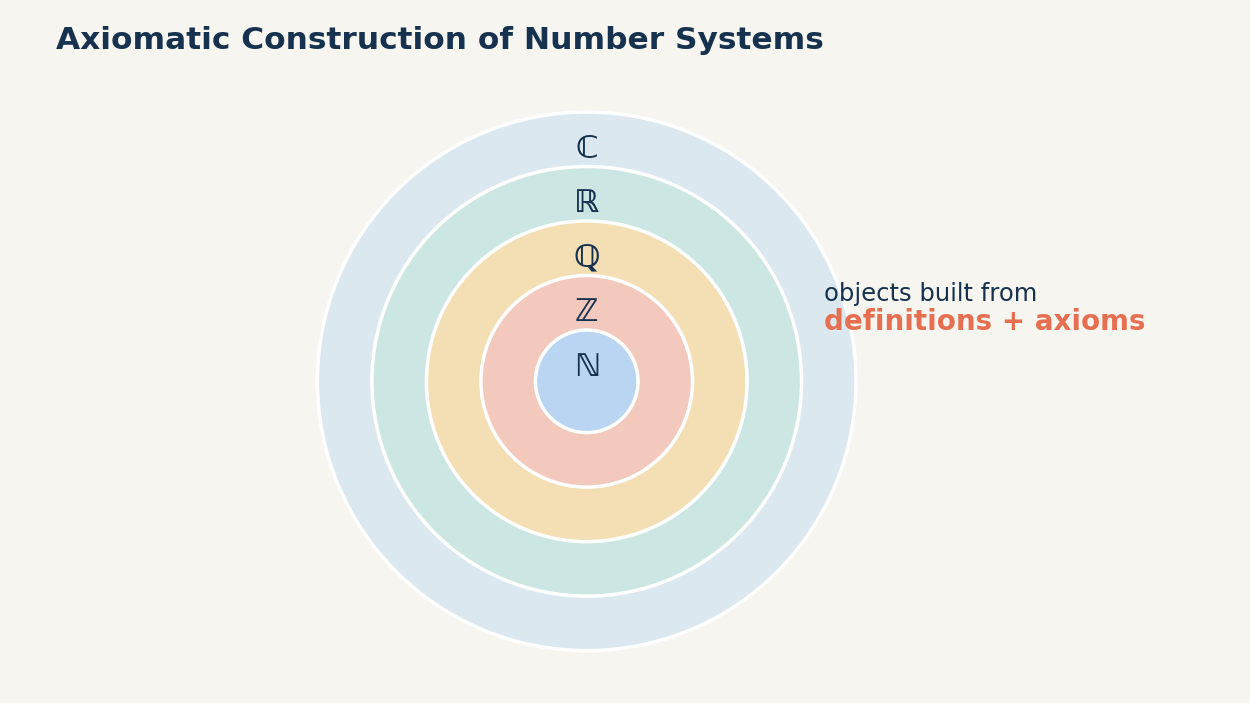
Goals
- Translate the operations of an axiomatic definition into small, behavioural Go interfaces.
- Compose interfaces to model number systems and structures such as sets, points, vectors, regions, graphs, and manifolds.
- Write algorithms against the abstraction, then test that different implementations obey the required mathematical laws.
Method
Treat an interface as a contract for observable behaviour: the methods expose the permitted operations, while documentation and tests record laws that a Go type cannot enforce by its signature alone.
- Isolate primitive behaviours such as equality, addition, multiplication, order, membership, and mapping.
- Build larger concepts by embedding smaller interfaces—for example, additive and multiplicative structures into real numbers, or finite maps into points and vectors.
- Implement more than one concrete representation and reuse the same algorithms for square roots, distance, region subdivision, or graphing.
- Check identities, inverses, closure, dimensions, and other invariants with law-based tests, and identify assumptions such as completeness that remain outside the type system.